Dromore
County
Down
They Came From Dromore
William Gibson
Mr Gibson was a native of County Down
Northern Ireland, Born in 1840, and died age 74
on the 1st.of November 1913 at the Princes Hotel, Hove,
Sussex. leaving an estate of the
value of £305,601. The son of a small
farmer in Drumbroneth Dromore. He was an
apprentice to James Crozier, a watchmaker, of North Street, Belfast and
subsequently opened his own business in the same street. The business was
wrecked in the 1864 riots and in 1865 he acquired new premises on the corner of
Donegall Place and Castle Place, which became familiarly known as
Gibson’s corner. He bought out the businesses of Hugh McCormick and Joseph
Lee, both successful jewellers, and established his own business as one of the
foremost jewellers of its day. This business was registered as Messrs. Gibson
& Co., Ltd in 1891 and continued to be the leading firm in the trade,
not only in Ireland but also in the UK.
. Before his death, William Gibson was offered a
Peerage. . As a small boy he was apprenticed to his uncle a watch maker in
Belfast. He was diligant and industrious and at the age of 27 he set up his
own business, first in North Street and then in Castle Junction "Gibsons
Corner". His range widened to include Silver and gold objects of very high
quality, exhibited in the U.S.A. and Paris, where he won prizes. He had his
own registered assay mark, he presented very elaborate silver cups to the
Royal Ulster Agricultural Society and a magnificent gold mace to Queens
University Belfast, this is still used at each graduation ceremony.
At the time of his death in 1913, he was
so well known in London that a special train was run from London to bring the
Lord Mayor, Aldermen and leading businessmen to his funeral.
William Gibson was one
was one of those fortunate and shrewd men in whose hands every venture
prospered and everything he had touched "turned to gold".
The
business expanded very rapidly and was eventually formed into a limited
company. In 1884 the business had grown so much, premises were aquired in
Regent street London and there a branch was initated which ultimatley became
the Goldsmith and Silversmith company (limited). Another business which
William Gibson started in Regent Street was sold to Mappin & Webb Limited,
William Gibson also purchased the farm in Drumbroneth, Dromore where he had
been born, and built a large house there, Drumbroneth House, in which he
resided while on business trips to County Down. Drumbroneth House is now
owned by Mr. Victor Shields, who with his family now reside there.
William
Gibson left in his will approximately a quarter million sterling, to set up a
trust for providing sons of farmers in County Down and Antrim with
educational advantages, the scheme will be known as The Gibson Trust Fund. He
also left £500 to Dromore Non Subscribing Presbyterian Church
Gibson
Scholarships (F247)
These
scholarships, founded in 1913 under the will of William Gibson, Belfast and
London, for the promotion and encouragement of education in agriculture and
the cultivation and management of land for profit, are awarded to
undergraduates and postgraduates of the University who were born in Northern
Ireland. Preference will be given to students born in County Down or County
Antrim and to undergraduate rather than postgraduate candidates.
1. A
postgraduate scholarship was established in 1976 and will be available
thereafter as funds permit. Applicants should be graduates of the Faculty of
Agriculture and Food Science of this University. The holder will undertake
full-time research in Agriculture or Agricultural Science in the Faculty of
Agriculture and Food Science and may register for a higher degree of the
University.
2. The
scholarship will be tenable for up to three years and its value will be
£2,335, subject to annual review, plus fees with an allowance of £200 per
annum for approved expenses.
3. The
scholarship will be awarded on the recommendation of a Board of Electors
consisting of the Dean of the Faculty of Agriculture and Food Science and
three other persons nominated by Faculty from among the members of the
Faculty.
4.
Candidates must apply to the Dean of the Faculty of Agriculture and Food
Science normally not later than May 1 in the year in which the scholarship is
offered.
Application forms may be obtained from the Dean's Office.

Belfast Corporation
In 1912 the Corporation decided
to acquire a new Mace. Designed by John Vinycomb, and made by the Belfast
goldsmiths William Gibson & Co., the new Mace was first used in 1913, the
tercentenary of the granting of the Charter by James 1, and has been used ever
since. It measures 49 inches in length, 6 inches in diameter at the head and
11.5 inches in the stem. The head is decorated with the Belfast Arms, the
Royal Arms, the Arms of the Province of Ulster and the Harp of Ireland, all
surmounted by an imperial crown and surrounded by Celtic-style ornamentation.
Inside the crown, the flat circular top bears an inscription consisting of the
legal title of the City and the date, with the names of the Lord Mayor, High
Sheriff and Town Clerk in 1912, round a gold sovereign showing the head of
George V The staves carried by the two
Sergeants-at-Mace were
presented by Councillor
Frederick H Lewis in 1869.

The new mace 1913
Queens University Belfast
The precious 18 carat gold mace, given to Queen's in 1909
as a celebration of its new status as a University, is back in service at this
week's ceremonial graduation processions, after recent restoration at Garrards.
The top London jewellers were in the headlines last year when Jade Jagger,
daughter of Rolling Stone Mick, became their creative director.
A mace was originally a weapon intended to prevail over an
armoured adversary. As long-range weapons were developed, such as the musket
and the longbow, the mace was relegated to a ceremonial role. It denotes
authority and the bearer of the mace in academic processions 'guards' the
Chancellor in the tradition in which medieval sergeants-at-arms marched as
royal bodyguards.
The Esquire Bedell bears the mace in the Queen’s academic
procession. He or she leads the Chancellor or Vice-Chancellor into the
ceremony and puts the mace on a stand on the stage, which is the cue for
members of the academic procession to remove their head dress. The Esquire
Bedell also looks after the honorary graduate, leading him or her out at the
end of the ceremony. The mace is always present during the conferment of
degrees.
The head of the Queen's gold mace is set with four
allegorical figures with the crest of Queen's University surrounded by semi
precious stones. There is a Celtic cross finial and tapering stem with the
words "The gift of William Gibson, a citizen of Belfast 1909."
Mr Gibson, the benefactor who presented the mace to
Queen's, was born in Dromore, County Down in 1840. He began his career as an
apprentice watchmaker in North Street, Belfast and eventually established his
own firm Mssrs. Gibson & Co. Ltd in 1891, which became the leading jewellery
firm in the UK. They produced only the highest class of goods and the
warehouse in Donegall Place and Castle Place was the chief source of supply in
Belfast for everything connected with the watch and jewellery trades.
In a fitting coincidence, the modern-day exclusive
jewellers Garrards, who restored the mace in May to its original splendour,
had amalgamated in 1952 with the company set up in London by William Gibson in
1880 - the Goldsmiths and Silversmiths Company of Regent Street, London. The
mace will return to Garrards later in the year, along with the University's
Hart silver collection, to be placed on show in an exhibition next summer in
the Gilbert Collection, Somerset House
The precious 18 carat gold mace, given to Queen's in 1909
as a celebration of its new status as a University, is back in service at this
week's ceremonial graduation processions, after recent restoration at Garrards.
The top London jewellers were in the headlines last year when Jade Jagger,
daughter of Rolling Stone Mick, became their creative director.
A mace was originally a weapon intended to prevail over an
armoured adversary. As long-range weapons were developed, such as the musket
and the longbow, the mace was relegated to a ceremonial role. It denotes
authority and the bearer of the mace in academic processions 'guards' the
Chancellor in the tradition in which medieval sergeants-at-arms marched as
royal bodyguards.
The Esquire Bedell bears the mace in the Queen’s academic
procession. He or she leads the Chancellor or Vice-Chancellor into the
ceremony and puts the mace on a stand on the stage, which is the cue for
members of the academic procession to remove their head dress. The Esquire
Bedell also looks after the honorary graduate, leading him or her out at the
end of the ceremony. The mace is always present during the conferment of
degrees.
The head of the Queen's gold mace is set with four
allegorical figures with the crest of Queen's University surrounded by semi
precious stones. There is a Celtic cross finial and tapering stem with the
words "The gift of William Gibson, a citizen of Belfast 1909."
Mr Gibson, the benefactor who presented the mace to
Queen's, was born in Dromore, County Down in 1840. He began his career as an
apprentice watchmaker in North Street, Belfast and eventually established his
own firm Mssrs. Gibson & Co. Ltd in 1891, which became the leading jewellery
firm in the UK. They produced only the highest class of goods and the
warehouse in Donegall Place and Castle Place was the chief source of supply in
Belfast for everything connected with the watch and jewellery trades.
In a fitting coincidence, the modern-day exclusive
jewellers Garrards, who restored the mace in May to its original splendour,
had amalgamated in 1952 with the company set up in London by William Gibson in
1880 - the Goldsmiths and Silversmiths Company of Regent Street, London. The
mace will return to Garrards later in the year, along with the University's
Hart silver collection, to be placed on show in an exhibition next summer in
the Gilbert Collection, Somerset House

The gold mace gifted by William Gibson to
Queen’s University in 1909 that has been restored at Garrards jewellers. Mrs
Jill Lyttle, Undergraduate Associate Dean of the Faculty of Legal, Social and
Educational Sciences, one of the Queen’s University’s Esquires Bedell, who
carried the mace in Monday’s ceremonial graduation processions., with
Chancellor Senator George Mitchell.
Dromore
connection with the Crown jewels
Garrard & Coy Ltd.
A leading London firm of
jewellers, Goldsmiths & Silversmiths, founded by GeorgeWickes later becoming
Wakelin & Taylor, and then Robert Garrard, 1758-1818. In 1843 they were
appointed as Crown jewellers, in which capacity it has since been responsible
for the maintenance of the regalia and the crown jewels and their preparation
until 1946 and in 1952 was amalgamated with the Gold & Silversmiths Co.
founded in 1880 by William Gibson and John Langman and resides at 112 Regents
St. London. Still maintaining the name Garrard and still the Crown jewellers
From "Industries of Britain"
William Gibson & Co., Manufacturing Jewellers and
Silversmiths,
Watchmakers and Opticians
Donegall Place and Castle Place, Belfast.—This eminent
house was founded by Mr. William Gibson in the year 1865, and has since
amalgamated its business with that of the Manufacturing Goldsmiths' and
Silversmiths' Company of Regent Street London
Doubtless the largest
manufacturers of fine jewellery, silver, and electro-plate, &c, in England.
This has given the house a distinct advantage over the majority of its
competitors, and enables it to offer to the public valuable opportunities of
obtaining the newest designs and highest finish and quality of goods at
manufacturers' prices. The purchaser is thus enabled to save something like
twenty-five per cent, on ordinary retail prices, and to secure goods of a very
superior class at about the same figures as those hitherto quoted to the
trade. Messrs. Gibson's business has been very successful from the first, and
its prosperity is continuous under the able and energetic management it
enjoys. It is carried on at the above address in splendid premises,
constituting one of the finest establishments in the goldsmiths',
silversmiths' and watchmaking- trades, and the stocks here displayed are of
surpassing beauty and interest, and of immense-value; -This fine-building is
The firm's own property, the ground and first floors being used as showrooms,
"while the top flat is occupied by the numerous staff of skilled workmen here
employed. Messrs. Gibson have their general factories at Newcastle Place,
Clerkenwell, London, and at Rue Martel, Paris ; and they have recently
purchased the manufacturing business and retail shops of Messrs. Mappin
Brothers, of Sheffield and London. They produce only the highest class of
goods, the quality and finish of all their manufactures being unexceptionable,
and these are all sold at the smallest possible margin of profit. An
exceedingly large and far-reaching business is controlled, and the house
enjoys the support and patronage of a most valuable and. influential
connection. The warehouse in Donegall Place and Castle Place is regarded as a
chief source of supply in Belfast for everything connected with the watch and
jewellery trades, and the spacious show-rooms here are replete with beautiful
productions in gold and silver ware, watches, clocks, gem jewellery, and works
of art, the mere enumeration of which would require a small volume. Messrs.
Gibson & Co. are manufacturers of gold and silver medals for the Commissioners
of Intermediate Education, Ireland ; and they hold a great number of prize
medals awarded to them at the leading exhibitions " for originality in
high-class jewellery and fine watches." The business is conducted with
conspicuous ability and enterprise in all departments, and the firm have
lately issued a most interesting booklet entitled " Precious Stones and
Bric-a-Brac." This beautifully printed and tastefully illustrated little work
has achieved great success and favour, and is a wonderfully useful and
instructive guide to connoisseurs and others, giving much valuable information
on the subject of which it treats, and showing the various marks found on
articles of jewellery and bric-a-brac to determine the place of their origin
and manufacture.
Gibson had factories in Clerkenwell
London, and Rue Martel in Paris, and in 1891 purchased the business and retail
shops of Mappin Bros of Sheffield and London. The Company exhibited in
Philadelphia, Paris and Chicago and Gibson was awarded the cross of the Legion d’Honneur.
Messrs. Gibson & Co., Ltd. was the
largest manufacturer of fine jewellery, silver and electro-plate in England.
They produced only the highest class of goods and enjoyed the patronage
of influential people. The warehouse, in Donegall Place and Castle Place, was
the chief source of supply in Belfast for everything connected with the watch
and jewellery trades. Their showrooms displayed gold and silverware,
watches, clocks, gem jewellery and works of art.
Messrs. Gibson & Co. was also
manufacturers of gold and silver medals for the Commissioners of Intermediate
Education, Ireland.
The Company received many prize medals
for ‘originality in high-class jewellery and fine watches’.
In 1880 Gibson went into partnership
with John Langman and founded the Goldsmiths’ and Silversmiths’ Company, of
Regent Street, London. In 1898 it became the Goldsmiths’ and Silversmiths’ Co.
Ltd. Their hallmark was originally W.G.& J. L. then became G. & S. Co. Ltd.
The Company was a major concern
producing diamonds, jewellery, bridal gifts, watches, clocks and silver and
electro plate. It had substantial premises covering a quarter of an acre, on
the corner of Regent Street and Glasshouse Street, which included a tea room
for the benefit of its clients. In 1928 premises were totally rebuilt and went
on to become the designated house of Garrard and Co Ltd, the Crown jewellers,
with whom the Goldsmiths and Silversmiths Co. Ltd amalgamated in 1952.
Gibson died at the age of seventy four
on the 1st November 1913 at the Princes Hotel, Hove, Sussex ,
leaving an estate in the UK of a value of £305,601. After several bequests
including £10,000 to Queen’s University, for establishment of special
agricultural scholarships, Gibson directed that the residue of his property
(about £150,000) should be used ‘for the purpose of assisting poor and
deserving farmers and holding farms in County Down and County Antrim,
Ireland’.
Gibson spent a lot of his time at the
Villa Lisnacrieve in Cannes and he also had a house overlooking Hyde Park,
London. He was a Unitarian and a Unionist, although he did not take an active
part in Politics. He was a member of the Ulster Reform Club.
ULSTER HISTORY CIRCLE

19 May 2006 - Blue Plaque Unveiling - William Gibson
|
|
It was a fine May afternoon for the unveiling of a blue
plaque to one of County Down's illustrious sons at his former home, now
owned by Victor and Norma Shields who graciously hosted the event. The
Ulster History Circle was represented by Jimmy Hawthorne, Sean Nolan,
Victor Price, Jim Crawford and Pat Devlin. Councillor Jim McIlroy, Chairman
of Banbridge District Council attended in his official capacity and when
the time came performed the cermony. Also present were representatives of
the Dromore Historical Society; John Davis, Queen's University; Walter
Smyth, The Gibson Trust; Brian King of RUAS and his wife, Rev. Sam Peden
and Raymond Kelly whose County Down website profiled many local worthies
including William Gibson and who had come over from Scotland to see him
honoured. The Plaque was sponsored by Banbridge District Council.
The official proceeding were opened by Tom Shields. Jimmy Hawthorne gave
a brief account of the Ulster History Circle's work and mentioned that
there were two other plaques in the area, to Helen Waddell and John B.
Yeats. He thanked the Banbridge Council for their sponsorship and Victor
and Norma Shields for their hospitality. Sean Nolan spoke briefy about
William Gibson and his achievements and Jim McIlroy unveiled the plaque.
After the splendid repast provided by Victor and Norma the company
dispersed well satisfied with a impressive event, well attended, humourous
and convivial.
The photos give a flavour of the event.
|

Councillor Jim McIlroy, Chairman of
Banbridge District Council

Pat Devlin.

John Davis QUB, James Hawthorne and James Nolan from the Ulster History Circle,
Victor Shields, Jim McElroy chairman of Banbridge District Council, Walter
Smith from the Gibson Trust, Raymond Kelly and historian Tom Shields.

Drumbroneth House, Dromore, Built by William Gibson 1901,
now owned and resided in by Mr. Victor Shields and family

Victor & Norma's grandchildren
Gibson births & Marriages for
Dromore
| CHILD |
BIRTH |
FATHER |
MOTHER |
|
Eleanor Jane GIBSON |
7 Mar 1865 |
William GIBSON |
Eliza GAMBLE |
|
Mary Jane GIBSON |
31 May 1865 |
James GIBSON |
Dianna LOWERY |
|
Emily GIBSON |
29 Jul 1868 |
William John GIBSON |
Mary CUNNINGHAM |
|
Rachel GIBSON |
24 May 1868 |
George GIBSON |
Sarah CUNNINGHAM |
|
Mary GIBSON |
11 Apr 1869 |
Joseph GIBSON |
Rachel MARTIN |
|
Annie GIBSON |
1 Oct 1870 |
John GIBSON |
Eliza Anne MILLIGAN |
|
Henry GIBSON |
6 Jun 1870 |
Henry GIBSON |
Jane BRADSHAW |
|
Jane GIBSON |
16 Mar 1872 |
Henry GIBSON |
Jane BRADSHAW |
|
David Thomas GIBSON |
4 Jun 1873 |
William GIBSON |
Eliza GAMBLE |
|
Henry GIBSON |
26 Mar 1873 |
Joseph GIBSON |
Anne DICKSON |
|
David James GIBSON |
12 Apr 1874 |
Allan GIBSON |
Sarah McILRATH |
|
Joseph GIBSON |
3 Jun 1874 |
John GIBSON |
Sarah WRIGHT |
| |
|
|
|
| GROOM |
DATE |
BRIDE |
WHERE MARRIED |
|
Hugh DOAK |
02 Dec 1845 |
Jane GIBSON |
Dromore Church of
Ireland |
|
Robert GIBSON |
18 Dec 1845 |
Sarah McCOMB |
Dromore Unitarian
Presbyterian |
|
George GIBSON |
04 Sep 1846 |
Sarah CUNNINGHAM |
Dromore Church of
Ireland |
|
John GIBSON |
23 May 1851 |
Agnes BLACK |
Dromore First
Presbyterian |
|
David GIBSON |
20 May 1852 |
Elizabeth SCOTT |
Dromore First
Presbyterian |
|
John ROWAN |
21 Dec 1852 |
Martha GIBSON |
Dromore Unitarian
Presbyterian |
|
Samuel GIBSON |
23 Dec 1852 |
Margaret PATTERSON |
Dromore Church of
Ireland |
|
James GIBSON |
24 Dec 1852 |
Diana LOWRY |
Dromore Church of
Ireland |
|
William john GIBSON |
23 Dec 1853 |
Mary CUNNINGHAM |
Dromore First
Presbyterian |
|
Joseph GIBSON |
04 Aug 1853 |
Rachel MARTIN |
Dromore Unitarian
Presbyterian |
|
Robert SCOTT |
20 Jul 1853 |
Elizabeth GIBSON |
Dromore Church of
Ireland |
|
John KINNEAR |
29 Oct 1853 |
Sarah Anne GIBSON |
Dromore Church of
Ireland |
|
William James GIBSON |
27 Nov 1854 |
Margaret SLOANE |
Dromore First
Presbyterian |
|
David GIBSON |
05 Dec 1854 |
Rachael GILL |
Dromore Unitarian
Presbyterian |
|
James CROZIER |
19 Jan 1854 |
Anna GIBSON |
Banbridge Civil
Registrars |
|
William James GIBSON |
27 Nov 1854 |
Margaret SLOANE |
Dromore First
Presbyterian |
|
Joseph GIBSON |
25 Jun 1855 |
Anne DICKSON |
Dromore Church of
Ireland |
|
John GIBSON |
04 Jan 1855 |
Sarah MARTIN |
Dromore Unitarian
Presbyterian |
|
William GIBSON |
08 Jan 1857 |
Eliza GRAHAM |
Dromore Church of
Ireland |
|
Thomas MILLS |
21 Aug 1857 |
Mary Jane GIBSON |
Dromore First
Presbyterian |
|
Alexander GIBSON |
28 Aug 1858 |
Sarah BECK |
Dromore Second
Presbyterian |
|
James SCOTT |
19 Feb 1858 |
Jane GIBSON |
Dromore Unitarian
Presbyterian |
|
James COWDEN |
17 Sep 1858 |
Margaret GIBSON |
Dromore Unitarian
Presbyterian |
|
Thomas GIBSON |
02 May 1860 |
Nancy MAXWELL |
Dromore Unitarian
Presbyterian |
|
John GIBSON |
15 Oct 1864 |
Nancy MITCHELL |
Dromore Unitarian
Presbyterian |
|
Hugh LYNASS |
28 Oct 1864 |
Anne Jane GIBSON |
Dromore Unitarian
Presbyterian |
|
William GIBSON |
14 Feb 1865 |
Eliza GAMBLE |
Dromore First
Presbyterian |
|
Hugh GIBSON |
16 Oct 1865 |
Charlotte McCRACKEN |
Dromore Unitarian
Presbyterian |
|
Robert YOUNG |
04 Sep 1866 |
Flora GIBSON |
Dromore First
Presbyterian |
|
John GIBSON |
13 Nov 1866 |
Sarah McKEE |
Dromore Second
Presbyterian |
|
Thomson LAVERY |
03 Nov 1866 |
Sarah TITTERINGTON |
Dromore Church of
Ireland |
|
Joseph GIBSON |
01 Apr 1867 |
Catherine CONLON |
Dromore Church of
Ireland |
|
Abraham VAUGHAN |
04 Sep 1869 |
Ann Jane GIBSON |
Dromore Church of
Ireland |
|
Richard BEATTIE |
09 Aug 1871 |
Jane GIBSON |
Dromore Second
Presbyterian |
|
George GIBSON |
09 Oct 1874 |
Elizabeth MARTIN |
Dromore Church of
Ireland |
|
John GIBSON |
10 Jul 1874 |
Elizabeth POOTS |
Dromore Church of
Ireland |
|
Joseph GRACEY |
24 Dec 1878 |
Isabella GIBSON |
Dromore First
Presbyterian |
|
Robert GIBSON |
19 Dec 1878 |
Mary Anne SMITH |
Dromore Church of
Ireland |
|
James GIBSON |
09 May 1879 |
Isabella ROBINSON |
Dromore Church of
Ireland |
|
Samuel HANNA |
17 Jul 1879 |
Mary C. GIBSON |
Dromore Second
Presbyterian |
|
William McKEE |
03 Sep 1881 |
Margaret GIBSON |
Dromore Second
Presbyterian |
|
John GIBSON |
13 Jan 1881 |
Ellen BARCLAY |
Dromore Church of
Ireland |
|
William BROWN |
28 Feb 1882 |
Margaret GIBSON |
Dromore Church of
Ireland |
|
Joseph GORDON |
17 Nov 1882 |
Jane GIBSON |
Dromore Church of
Ireland |
|
George KIRKWOOD |
03 Feb 1883 |
Elizabeth GIBSON |
Dromore Church of
Ireland |
|
William John BOAL |
14 Sep 1883 |
Margt Ann GIBSON |
Dromore Unitarian
Presbyterian |
|
James GIBSON |
14 Apr 1887 |
Margt Isabella WILSON |
Dromore First
Presbyterian |
|
John GIBSON |
06 Jun 1887 |
Elizabeth Sophia GRAHAM |
Dromore Church of
Ireland |
|
Joseph GIBSON |
08 Jun 1888 |
Maggie CROZIER |
Dromore First
Presbyterian |
|
Thomas GIBSON |
23 Jul 1888 |
Eliza JOHNSTON |
Dromore First
Presbyterian |
|
John LINDSAY |
28 Mar 1888 |
Mary Jane GIBSON |
Dromore Church of
Ireland |
|
Alexander McNALLY |
02 Mar 1889 |
Elizabeth GIBSON |
Dromore Church of
Ireland |
|
Samuel John SMYTH |
02 Sep 1889 |
Sarah Ann GIBSON |
Dromore Church of
Ireland |
|
James GIBSON |
02 Oct 1891 |
Mary Jane GIBSON |
Dromore Unitarian
Presbyterian |
|
Edward MAGEE |
24 Jul 1891 |
Matilda GIBSON |
Dromore Church of
Ireland |
|
Thomas GAMBLE |
26 Dec 1892 |
Jane GIBSON |
Dromore First
Presbyterian |
|
Samuel GIBSON |
26 Dec 1892 |
Mary FERRIS |
Dromore First
Presbyterian |
|
John JOHNSTON |
03 Aug 1894 |
Jane GIBSON |
Dromore First
Presbyterian |
|
John CROZIER |
28 May 1894 |
Margaret GIBSON |
Dromore Church of
Ireland |
|
Joseph GIBSON |
17 Jan 1895 |
Ellen Ann CARGIN |
Dromore Unitarian
Presbyterian |
|
Richard GIBSON |
10 Jul 1897 |
Mary Ann PERRY |
Dromore First
Presbyterian |
|
John GIBSON |
11 Jan 1898 |
Jane WOODS |
Dromore Church of
Ireland |
|
Samuel Robert MONTGOMERY |
08 Oct 1898 |
Sarah GIBSON |
Dromore Unitarian
Presbyterian |
|
Robert John GIBSON |
25 Jan 1901 |
Ellen Ann THOMPSON |
Dromore Church of
Ireland |
|
William SMYTH |
22 Mar 1901 |
Margaret GIBSON |
Dromore Second
Presbyterian |
|
Samuel GIBSON |
05 Oct 1906 |
Emily MURPHY |
Dromore Church of
Ireland |
|
Walter WATSON |
04 Apr 1906 |
Jane McCreedy GIBSON |
Banbridge Civil
Registrars |
|
Walter WATSON |
04 Apr 1906 |
Jane McCreedy GIBSON
xxxx |
Banbridge Civil
Registrars |
|
John JOHNSTON |
03 Jan 1912 |
Elizabeth GIBSON |
Dromore First
Presbyterian |
|
David GIBSON |
18 Jun 1920 |
Eliza Jane Doak JAMISON |
Dromore First
Presbyterian |
Harry Ferguson
My whole
economic philosophy and all my efforts are guided by the knowledge that the
best way to improve the total economy will be through cutting the costs of
production of agricultural products, which control the cost of living. There
must be implements of an altogether new type which will produce, for the first
time in history, enough food to feed all the people of the world. And, also,
produce from the land - the source from which all wealth comes a new wealth to
enrich the world.
Our Plan for
prosperity, security, and peace can be stated in two simple propositions:
1. Make the good
earth produce more than enough to keep its whole population in comfort and
contentment.
2. And, what is equally vital, produce 'more than enough' at prices which the
people of the world can afford to pay.
That is our
ambition. That is the course to which I am wholly dedicated.
Harry Ferguson
Detroit, Michigan
December 1, 1947
The son of a
farmer, Harry Ferguson was born on 4th November 1884, at Growell, County
Down, and christened Henry George, although he was always known as Harry. The
family farm covered 100 acres, a large holding in Ireland at that time. Harry
disliked farm work and quickly became interested in mechanical things, joining
his brother Joe in his cycle and car repair business in 1902. There Harry took
an interest in flying. He had been fascinated by flying since following the
exploits of the Wright brothers in the United States and went to several air
meetings and exhibitions, particularly in France in 1907 and 1908, and then
went back to Ireland and designed and built his own monoplane. After many
adventures trying to fly this plane (he had to learn the hard way - there were
no instructors), he finally succeeded and flew for the first time on 31st
December 1909, the first flight in Ireland. This was the same year that
Bleriot made the first flight over the English Channel. From accounts that I
have read, Harry spent more time crashing than he did flying. On one
particular occasion during an early flight ,a gust of wind caused the aircraft
to vere and summersault, the result being that Harry and the engine both fell
out. It is believed that Harry's plane was the first to feature tricycle
undercarriage, he also took up the first passenger in Ireland, a very brave,
or foolish, lady by the name of Rita Mart, who had travelled from Liverpool to
make the flight on 23rd August 1910.
His brother Joe
did not like the flying, and, as he could not see any benefit to the company
and was concerned for Harry's health, this led to many arguments. The two
eventually decided to go their separate ways, Harry setting up in business as
May Street Motors in 1911. The company name was changed to Harry Ferguson Ltd
about a year later. There Harry sold Maxwell, Star and Vauxhall cars. Harry
competed in a Vauxhall car in local hillclimbs and speed events in which he
proved to be quite successful. In addition to the cars, Harry Ferguson Ltd
also held the franchise for Overtime tractors. With this involvement, Harry
was well qualified to take on the task of educating the farmers of Ireland in
the new ways with tractors. He was engaged by the government to demonstrate
tractors during the first world war. The problem with these early tractors was
that they were very heavy, had iron wheels and a large flywheel. The weight
caused compaction of the soil, and the steel wheels, while not allowing any
slippage, caused other problems. When a tree root or under soil object was
encountered by the plough or cultivator, the wheels would not spin, and this
either caused damage to the implement or the tractor. With the energy stored
in its large flywheel, it rotated around the rear wheel with dire consequences
for the driver. There were on the market several devices to stop the tractor
tipping over backwards, but Harry's fertile mind had the idea to somehow make
the tractor and plough one unit and use the suck of the soil as weight for
grip, thus allowing the size of tractor used to be smaller, causing less
compaction.
The first
attempt at joining the tractor and plough in one unit resulted, in 1917, in a
plough designed to go behind the Model T Ford car, which, for around £90,
could be converted into a tractor. This conversion was called the Eros. The
plough cost £28. This proved quite successful and sold in significant numbers.
After the Eros,
the most widely used tractor was the Model F Fordson, at the time one of the
smallest tractors available. The first attempts involved modifications to the
1917 plough with a mechanical linkage controlled through a slipper mechanism
which followed the furrow bottom. Ferguson went to America in 1920 to meet
Henry Ford and asked Ford to make the plough alongside the Model F tractor.
Ford was impressed with the outfit and offered Harry a job which he declined.
Harry went on another trip in 1925 where he met the Sherman brothers who
agreed to build the plough for sale. Business was good until Ford decided
during the Great Depression to stop tractor production. By this time Harry had
returned to Ireland to continue his experiments and his ambition of making the
plough depth wheel redundant.
During the late
twenties, Harry and his fellow engineers began experimenting with hydraulics
and eventually fitted a Model F with hydraulic linkage with promising results;
this system actually had lower link sensing. The tractor came to Norfolk in
1931 and was demonstrated to several influential people including William
Morris , in the hope that someone would build the tractor, as Harry and his
small team were engineers and not production men, Eventually frustration got
the better of Harry Ferguson, and, rather than try to persuade someone to
build a tractor using his patent linkage system, he built his first tractor.
This tractor was designed and built in Belfast, in 1933, using an l8hp
Hercules engine. Called the 'Black Tractor', due to its colour, it is normally
on display in the Science Museum in London. The gears for the 'black tractor'
were made by the David Brown Company of Huddersfield, who, after some
persuasion, became interested in building the tractor as a production machine.
An agreement was made, with David Brown to build the tractor and Harry
Ferguson Ltd to sell it. Designated the Model A, it cost £224, at a time when
a Fordson cost £140.
During the years
1936-38, 1350 Model A's were made, although their sales were not easy as the
tractor needed to be bought with its range of implements, each costing £28, in
order to get the best out of it. Consequently it proved rather expensive
although Harry Ferguson tried to get Browns to build it cheaper. Not being
happy with the set up between himself and David Brown, Harry took an example
of the Model A and demonstrated it to Henry Ford on his ranch at Fairlane, Nr
Dearborn, Michigan, U.S.A., in October 1938. Henry Ford was suitably
impressed, and, at a table in the demonstration field, he and Ferguson made
their famous Handshake Agreement'; Ford was to use his production capacity to
produce the tractor and Harry Ferguson Ltd would act as the salesmen. In
addition Harry Ferguson was to have the final say in any engineering changes.
The first
prototype was completed in March, just three months after work had begun, and,
on 1st April 1939, it was demonstrated to a few friends in Mrs Ford's nursery
garden at Fairlane. The first production tractors were ready by June, and, on
the 12th June, everything was ready for a demonstration to distributors who
had been appointed. The public launch came on 29th June with over 500 people
being invited. The agreement worked well throughout the war period although
Harry was frustrated that the Ford tractor plant at Dagenham, England, would
never agree to build his little tractor. Between 1939 and 1947 some 306,000
examples of the Ford/Fergie or 9N, were made.
Although never
built in the UK, a version was imported during the war. This tractor, the
2NAN, was built without electric start and ran on steel wheels. Ford engineers
wanted more involvement in the design of the tractor and suggested that the
gearbox be increased from three speeds to four speeds and position control be
incorporated in the hydraulics. Ferguson would not agree to either of these
changes, although his engineers were thinking along similar lines. In 1947,
Ford prepared to release a new tractor, called the 8N, incorporating the above
changes and unmodified Ferguson System Hydraulics. This tractor angered Harry
Ferguson as his patents were being used without his consent, and he sued Ford
successfully for $9.25 million. Production of this tractor was stopped in
December 1952.
While the court
case was going on with Ford, Ferguson had arranged with Sir John Black, of the
Standard Motor Co, to produce a tractor to his design. As the Standard Co
owned a factory at Banner Lane Coventry, which had been a shadow factory
during the war, it was turned to tractor production in 1946, and the TE
(Tractor England) was born. These were initially powered by a Continental
petrol engine, until the engine that was being designed and made for the
Standard Vanguard was in frill production. Diesel engined versions were
available from January 1951. Production of the TE continued in all its 16
guises until 1956, and, when production stopped, 517,651 tractors had been
produced. With the Ford deal at an end, Harry Ferguson set up a separate
company in America to produce the equivalent of the TE, the TO. The TO
(Tractor Overseas) was produced by Harry Ferguson Inc. at Detroit between 1948
and 1954, a total of 140,000 being made.
During the early
fifties, negotiations started between Harry Ferguson Ltd and Massey Harris for
the amalgamation of the two companies and product lines. These negotiations
were long and drawn out as Harry Ferguson insisted that he have control over
design changes. Eventually an agreement was made, and the first tractor of the
amalgamation, the FE35, rolled out of Banner Lane in October 1956. Known as
the Grey/Gold 35, this tractor was produced by Massey-Harris-Ferguson. During
the following months, further negotiation took place with the result that by
the end of 1957 Harry Ferguson had sold all his shares in the
Massey-Harris-Ferguson Co. During the negotiations, Harry insisted that his
share of the company was worth $17 million, however, the Massey Harris
directors would only go to $16 million After some time in a stalemate
situation, Harry eventually suggested that they toss for the extra million.
Eventually the directors of M-H agreed and a half crown was duly tossed, Harry
called tails; he lost. He then suggested that they toss again for the coin,
and this time Harry won. The directors had the coin mounted on a cigar box
with the inscription, 'To our friend and partner Harry Ferguson. A gallant
sportsman'. Harry received $16 million (then £5.7 million) for his shares in
M-H-F.
The 'FE achieved
many milestones during its production span, with over 517,000 being built at
Coventry alone. The tractor was exported throughout the world and made
significant advances to the world's food production. Harry Ferguson always
maintained that it took five acres to feed a pair of draft animals, but, with
his tractor, this land could be put to use producing food for the growing
population of the world. One of the more unusual feats that the TE achieved
was in 1958 when Sir Edmund Hilary travelled to the South Pole using three of
the little tractors. The tractors proved reliable over the 1200 mile journey
and, despite high fuel consumption in the extreme conditions, proved more
able than an ex-army Weasel, which had to be left behind. Hilary gave the
tractors to the Americans who were manning the Antarctic station in exchange
for a flight out, and they remained there for some years being used for
further survey work. Of the three tractors that travelled to the Pole, one is
still there, one is in New Zealand and the other returned to the UK in 1965 to
take up residence in the Massey Ferguson Heritage Centre at Coventry.
For many years
Harry Ferguson had been considering at the back of his mind the problems of
the motor car and now turned his energies to this. He had been interested for
some time in the work of two engineers; Tony Rolt and Freddie Dixon. For many
years they had been working with four wheel drive systems and had been
demonstrating to the Army a vehicle built for military purposes, known as the
'Crab'. It had four wheel drive and steering by swinging both axles which
caused some novel handling. Ferguson, upon his return from America, went to
see the two at work, and, in 1950, Harry Ferguson Research was formed. Claude
Hill joined the team from Aston Martin soon after, and work began on building
a complete car.
The car had
revolutionary features; four wheel drive, anti lock brakes and torque
converter transmission. Even the engine was of Ferguson design, being a flat
four which gave a low centre of gravity. Ferguson Research had bought, from
Count Teramela, the rights to the Torque Converter for about £500,000. The
intention was to sell the ideas to a large motor manufacturer to produce the
production version, as had been the intention with the tractor. A total of
three prototype road cars were built, two estate cars and a saloon. The last
estate car R5/2, built in 1959, also incorporated a supercharged version of
the Ferguson flat four engine. This gave the engine an output of 150bhp from
the 2.2 litres. In testing, this vehicle was regularly lapping the Motor
Industry Research Authority test ground at 100 mph. Unfortunately the engine
is no longer in the car, although both can be seen in the Museum of British
Road Transport in Coventry.
After the road
cars, Ferguson Research turned to racing to prove the worth of the Ferguson
Formula System. A racing car was built, designated P99, that conformed to the,
then current, Formula 1 regulations. However, all the forward thinking in the
transmission, was to no avail, as the car was front engined at a time when
John Cooper and most other designers were successful with rear engined cars.
The car was entered for several races by Rob Walker, including the Oulton Park
Gold Cup in 1961, where it was driven by Stirling Moss. To the delight of the
Ferguson engineers the race was wet, and the combination of four wheel drive,
anti lock brakes and Stirling's driving proved too much for the opposition,
and he won the race. P99 did, however, prove to be unbeatable in the Hillclimb
Championship in 1964, where it took Peter Westbury to the Championship. The
car now resides in the Donington Collection.
Several others
experimented with four wheel drive in racing cars, and the Ferguson Formula
was used at Indianapolis in 1969 and in a Lotus 56b turbine Fl car during
1971. Harry Ferguson did not see the racing car win its race, as he died in
1960. He suffered great bouts of depression and insomnia in the latter years
of his life but still had flashes of his old brilliance and stamina. On one
occasion when on holiday in Jamaica, he awoke to find a burglar in his room.
In the ensuing struggle the robber's gun went off, and Harry sustained a
bullet through his leg. Later, when the robber was brought to court, in his
defence he said that he had been savagely attacked by Harry Ferguson. Harry
Ferguson's original ideas are still employed. No matter what colour of
agricultural tractor, they all have the converging three point linkage and
weight transfer system that Harry pioneered. Many modem road vehicles have
four wheel drive technology, and those produced by Vauxhall/Opel, Ford,
Mitsubishi, Honda, Land Rover, Lancia, Alfa Romeo and others employ the
Ferguson patented Viscous Coupling control system, developed by GKN and FF
(Ferguson Formula) Developments, a company owned by Ferguson's old partner
Tony Rolt and his son Stuart.
For those of us
in agriculture Harry Ferguson revolutionised the farm tractor and saved us all
a great deal of hard work. For the general public, his ideas, firstly for
aviation and now employed by the motor industry, have made a great
contribution to human development. Harry Ferguson, although a very slight
figure of a man, proved a giant in the engineering field.
|
Prices:
Ferguson Tractors. Ex
Works - March, 1954 |
| |
Diesel Tractor
(TEF)
Petrol Tractor (TEA)
V.0. Tractor (TED)
Narrow Track Petrol Tractor (TEC)
Narrow Track V.0. Tractor (TEE)
Vineyard V.0. Tractor (TEL) |
£525.00.00
£395.00.00
£405.00.00
£435.00.00
£445.00.00
£465.00.00 |
| |
| Ferguson
Accessories |
| |
Hinged Seat and
Footrest Assembly
Hitch Conversion Unit
Lighting Set
Lighting Set (Side) |
£3.10.00
£10.15.00
£11.15.00
£6.10.00 |
| |
| Fitting
charges |
| |
In Workshops
On Farm |
£2.00.00
£3.10.00 |
| |
PITTSBURG AND
HER PEOPLE
GEORGE B. KELLY, of Braddock, near Pittsburg, Pennsylvania, a
dealer in real estate, was born January
31, 1856, son of William Guy and Mary
(McCracken) Kelly, he being one of twelve children, five of whom
survive. The
parents were both natives of Dromore, county Down, Ireland, and were there
married. In 1845 they emigrated to this country with their three children,
and remained at Albany, New York, two years, and then
came
to Allegheny county, Pennsylvania, via the canal. They located at
Wilkins-burg, where they followed farm life. He 'died in 1876, aged sixty-nine
years. In politics Mr. Kelly was a Republican. In religious faith the family
was, while living in their native country, members of the old Covenanters, but
upon coming to this country
became
connected with the United Presbyterian church. Mrs. Kelly died in 1894, aged
eighty-six years. Their surviving children are: Robert, a contractor, of
Wilkinsburg, Pennsylvania; Samuel, of the Kelly-Wood Real Estate Company,
Pittsburg, Pennsylvania; Anna, wife of William Beam, of Rummerdale,
Pennsylvania; Sarah, wife of William McHenry, Pittsburg, Pennsylvania; George
B., of this sketch.
George B. Kelly was
only permitted to acquire but a limited education in the country schools, and
at the age of twenty-two years left the farm and came to the city of Pittsburg
and engaged in the live-stock business at the city stock-yards. He was thus
connected for several years, and in 1890 engaged in the real estate business
at East Liberty, and still follows the same in a most honorable and
satisfactory manner.
Dromore and District Local Historical Group
Journal
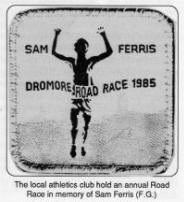
SAM FERRIS "MARATHON MAN"
BY TREVOR MARTIN
Most of us this summer enjoyed the spectacle of the greatest of the worlds
athletes gathered in Barcelona to compete for Olympic gold. The marathon, held
over 26 miles represents for many the pinnacle of endurance, tactics and true
grit. The games of 1924 were held in Paris and anyone who watched the film
"Chariots of Fire" would have been given a good impression of the period,
styles and equipment of the runners.
There were many famous names at these games Paarvo Nurmi winner of nine
gold medals, Eric Liddell who refused to race in the 200 metre final because
it was held on a Sunday, Johnny Weissmuller winner of five swimming golds and
later to become the screen Tarzan. Amongst all these world famous characters
was a man from the town of Dromore, Sam Ferris, one of the greatest distance
runners that Northern Ireland and the United Kingdom was ever to produce, made
his Olympic debut.
|
Sam Ferris was born in the townland of Magherabeg near Dromore in August
1900 which coincidently was the year of the second
Olympic Games, also held in Paris. Sam's mother Minnie Clarke was said to be a
bit of an athlete and it was not unknown to see her running through the fields
hurdling the stooks of corn. Sam lived for the early period of his life at
Magherabeg, however he moved to Glasgow with his father when his mother
tragically died. They only stayed in Glasgow for a few years, returning to
Dromore to the rest of the family. Sam was like his mother, always interested
in running and at the early age of seventeen he joined Shelteston Harriers,
winning many prizes in the Junior Open Category.
Sam was also used by the local pigeon men to run in the rings of the first
birds home as there was only one pigeon clock in the Town, thus giving them an
extra time advantage over their colleagues.
When Sam was eighteen the First World War had been raging for four years,
so like most young men of his age he decided to join up. He joined the
fledgling Royal Air Force, then known as the Royal Flying Corps and on
enlistment he was posted to India. During that posting, however, he did little
or no running, preferring to devote his energy to other sports such as
football. After his service was up he returned to Dromore, once again taking
up his first love of running. He didn't have to wait long for success winning
many local races including the Co. Down One Mile Championship. |
 |
In December 1923 he rejoined the Royal Air Force and was stationed in
Uxbridge where he competed in a cross country race. Although he only came
third his talents came to the notice of Bill Thomas of Herne Hill Harriers who
persuaded him that his true forte might be long distance rather than cross
country running. Bill Thomas's entreaty had an effect on Sam and he joined
Herne Hill Harriers with whom he stayed throughout his career. Many young men
who had fought in the war were taking to serious athletics, Bobby Mills who
had been awarded a Distinguished Flying Cross in the Royal Flying Corps won
the 1920 Polytechnic marathon, although prior to the race had never run
further than 14 miles. Sam's first 20 mile race was not a success so it was
important for him to build up the stamina necessary for long distances.
 |
In
the 1924 Olympic trials there were 80 starters one of whom was Sam Ferris
competing in the first ever marathon race of his career. Despite conditions
being poor and a lack of experienced runners in the field, by the 23 mile
point 3 runners were well in the lead. Ahead of Sam in first and second place
were Duncan Wright and Jack McKenna. McKenna was in all sorts of trouble and
collapsed with exhaustion just past the 25 mile point. Ferris, although
exceptionally strong, could not catch the Scotsman Wright who finished in
2.53.47, only 45 seconds in front. It would appear therefore that Bill Thomas
was right and Sam's talents lay in the longer distances. It was as a result of
this achievement that he was picked for the British Olympic team to compete in
Paris in 1924.
The marathon team for the Olympics was Jack McKenna, Duncan Wright and Sam
Ferris and of the three runners who finished in the best position. The heat
combined with the route chosen for the course, much of it over cobbled roads,
led many including Wright to drop out; the only time that Wright was ever to
fail to complete a marathon. Sam's fifth place in 2.52.26, behind the eventual
winner Alban Stenroos of Finland was the best achievement to date for a
British runner in an Olympic marathon. The achievement is even better when we
see that at the 23km mark Sam was 30th and even after 35km was only 9th. The
omens looked good, what might he achieve in future years as it is generally
thought in the world of running that marathon runners reach their peak much
later than those at the shorter distances?
|
Sadly for Sam he was to be bitterly denied Olympic gold for although he
competed in two further Olympics, (Amsterdam in 1928 and Los Angeles in 1932)
the gold was tragically to elude him. It was the 1932 games in Los Angeles
that was perhaps to prove to be his greatest disappointment for through a
combination of fate and bad management he lost the gold medal. In later years
he was to relate this story, one that best illustrated the lack of a
co-ordinated and professional approach on behalf of the administrators of the
British Olympic team in those early days. When Sam and Duncan Wright arrived
they were given no briefing on the course, indeed Sam only saw the course once
before the actual race. In contrast Juan Zabala of Argentina, the eventual
winner had trained on the course and knew it intimately. On race day they were
given their British running vests to find that they were much too long and
they both felt that it would be a disaster to use them in the competition.
Duncan Wright was adamant he would not use the vest and he eventually competed
wearing his own Scotland vest. Sam tried to redesign his vest cutting some
eighteen inches off it's length, but this was to prove catastrophic during the
race. After a distance into the race the vest began to ride up Sam's back
exposing the kidney area to the wind and causing it to chill. He stopped
several times during the race to adjust the vest eventually, holding it down
using the safety pins that held up his number. Despite this he ran well coming
up through the field until he had Juan Zabala in his sights. Once again Sam's
backup team were to let him down. He was told Zabala was going well and to
ease off for the silver medal. The truth was that Zabala had been through a
difficult period in the race and was on his last legs. A concerted attack by
Sam at this point would possibly have
finished him off. Sam finished 2.31.55, only nineteen seconds behind Zabala
and won the Olympic silver medal, with both runners breaking the world record.
|
Sam eventually got over his disappointment and raced on for many years,
increasing his tally of awards and honours both national and
international. He won the first ever AAA title to be contested, was victorious
in eight consecutive Polytechnic marathons and was runner up in the first
Empire Games in 1930.
He set a course record in Turin of 2.46.18 beating the Belgian, French and
Italian champions. They even came to England to get their revenge but, he
destroyed them winning in 2.40.32 a margin of five minutes. Course records
were his speciality, in Liverpool he came home in 2.33.00 some fifteen minutes
in front of the next man.
Sam, a strict non smoker held strong views on marathon running and indeed
training in general. A newspaper article written in 1931 said of him "In order that the novice may evaluate Sam Ferris, he must do as Sam Ferris
did, train wisely, train conscientiously and train
consistently. Spasmodic bursts of energy serve no useful purpose."
|
 |
His training for any marathon began some eight weeks before the race and
was set to a strict regime, one that he kept to and which served him well.
As a Warrant Officer in the Royal Air Force Sam served in many stations
throughout the world over the years, at Dieppe in 1940 he was the officer in
charge of evacuating the men prior to the advancing German Army.
Henry Fairley a local man and relative of Sam remembers spending time with
him, his wife and daughters in India in 1938. Sadly Sam died in the late
seventies but his widow Marjorie is still alive and living peacefully in a
cottage in Rosson-Wye, England. I'm sure that many who read this story will
like me be proud that a man from Dromore has written his name into Olympic
history.
I would like in my article to acknowledge the help of Seamus McKeown and
Henry Fairley for the invaluable information that they supplied in compiling
this incredible story of surely one of Dromore's greatest sons.
THOMAS STOTT-DROMORE'S FORGOTTEN POET
by ROY GAMBLE
They say a prophet has no honour in his own country. In Ulster
the same could be said of poets, or rather, the memory of them, for despite a
considerable legacy of soulful outpourings passed on by local rhymers, it
seems we are poor custodians.
Dromore is no exception. How many citizens know that the town
once could boast of a resident poet? It's a good few years ago of course (just
over a couple of centuries in fact), nevertheless, some of his writings are
still extant to-day.
Thomas Stott-the poet of Dromore, or as some called him, the
poet laureate of Down was no Keats or Wordsworth, nor did he claim to be. He
said of his poems: "They are the recreations of solitary hours snatched from
the hurry of business, furnishing innocent amusement and a proof that literary
recreation is not altogether incompatible with the pursuits of commerce."
And yet he was a reasonably prolific writer, contributing
regularly to numerous journals and newspapers, including the Belfast
Newsletter and the London Morning Post, where many of his poems appeared under
the pen-name 'Hafiz' (Arabic for observer).
No ploughman poet, like Robert Burns and John Clare, Stott was
born suckling the proverbial silver spoon, the son of a prosperous
Hillsborough linen merchant. He followed his father's calling and his first
poems were written when learning the linen trade in Waringstown.
He seems to have possessed a penchant for non-de-plumes. Not
only did he extensively employ the exotic 'Hafiz' he also used the colourful
pseudonym 'Banks of Banna' for some of his early poems, possibly in his
Waringstown days.
Stott eventually settled in Dromore, then a thriving linen
centre, and in 1777 he was married in the town's cathedral to Mary Ann
Gardiner, a lady of good connections originally from Coleraine.
Stott and his new wife set up home in 'Dromore House' - which
once upon a time served as the 'Clergy Widows Houses' - and rapidly built up a
growing business with several bleach greens in the meadows beside the Lagan.
Many of his poems reflect his great love of Dromore and its
citizens. Poems like: "The Mount of Dromore" in which he celebrates an annual
Easter Monday custom of youthful high jinks on the ancient Norman earthworks.
Then there is a satirical piece (shades of Orwell's 'Animal Farm') where some
educated pigs plead their case for a share of the 'Liberty, Equality,
Fraternity' that was sweeping Europe at the time. In the "Humble petition of
Dromore pigs" he writes:
". . . We the swine of Dromore
At a numerous meeting,
To all lovers of pork
This petition send greeting . . .
" And the poem ends:
"Dear liberty then
To us captives restore,
And our thanks shall resound
Through the streets of Dromore."
Incidently, it flows quite nicely to the tune of Master McGra.
Throughout his life Stott retained a passion for nature and
wildlife. A keen fisherman and gardener, the solitary hours spent on the river
bank and among the shrubs and flowers and fruitful trees of his garden must
have given him inspiration for such poems as: "the moralizing Trout", "To
May," "Sketch of a fine day in October," "To a woodlark," and not to be
outdone by his contemporary John Keats- "To Autumn," which he describes as -
"Crowned with sickle and the yellow leaf."
Stott was no effete poet. He possessed a fine business acumen
and thought nothing of setting out from Dromore on horseback to travel to the
brown linen markets in towns scattered throughout the province.
He wrote of such travels in a poem entitled "The Brown Linen
Buyers" in which he describes the homeward journey: "Well lined with beefsteak
and Irish champagne."
Dromore once had the honour of receiving a letter from the
great adventurer and romantic poet Lord Byron. Apparently some of Stott's
verse had attracted a scathing attack from Byron during a certain literary
controversy of the time. On learning, some time later, that Stott wrote merely
for pleasure and not for profit, Byron wrote to apologise for his earlier
inconsidered remarks.
In later years Stott struck up a close friendship with local
patron of the arts, Bishop Percy of Dromore. The memorial which stands in the
pinnacle meadow (which incidently was one of Stott's own bleach greens) was
raised by the poet in memory of the Bishop after his death in 1811.
Stott died in Dromore house in 1829. He was buried in the
cathedral churchyard, within sight of his home and not far from his beloved
Lagan.
His grave, fourth in line to the right of the main gate, is
marked with this badly faded inscription:
"In the humble hope of joyous resurrection.
Here rest deposited the earthly remains of Thomas Stott esq.
Born Hillsborough on 21st June, 1755
He departed this life at his residence in Dromore
The 22nd day of April, 1829.
In 1825, just four years before his death, Stott's one and
only book of poems "The Songs of Deardra" was published.
This slim volume, a few poems in decaying copies of ancient
Belfast Newsletters, a worn tombstone, and a painting hung in Castleward in
which the poet and Bishop Percy are prominent, is all that remains of the poet
of Dromore.
He never attained greatness and remained a minor poet only.
The evidence is that he never strove for greatness. As he wrote in the title
page of the "Songs of Deardra":
"And if the world should not prove kind,
As through its mazy paths ye stray,
Be not disheartened - fortune's blind,
And fame oft flatters to betray."
His poetry, even if it were readily available, would not be
much read today. The late 18th century style is somewhat ponderous, the words
pedantic. Nevertheless, he was a man of his time and as a poet he recorded
what he observed and loved best - the simple everyday scenes around Dromore
and among the meadows beside the Lagan.
In an age of instant electronic entertainment it is no longer
fashionable to read poetry. This is a sad passing. A poet, especially a local
one, is also an historian, and the writings of Thomas Stott provide us with a
tangible link with the past.
Whether or not he saw himself as a keeper of history we'll
never know. There is little doubt though that the urge to record the passing
scene was strong. Perhaps, as a modern poet puts it, "Of the fear of death -
the need to leave messages for those who come after saying, I was there, I
Joseph Mullin, 1811-1882
MULLIN, Joseph, a
Representative from New York; born in Dromore, County Down, Ireland, August 6,
1811; immigrated to the United States in 1820 with his parents, who settled in
Watertown, Jefferson County, N.Y.; attended the public schools; worked in a
printing office; attended Union Academy, Belleville, N.Y., and was graduated
from Union College, Schenectady, N.Y., in 1833; principal of Union Academy and
subsequently taught in the Watertown Academy; studied law; was admitted to the
bar in 1837; appointed examiner of chancery, supreme court commissioner, and
commissioner in bankruptcy in 1841; prosecuting attorney of Jefferson County
1843-1849; elected as a Whig to the Thirtieth Congress (March 4, 1847-March 3,
1849); president of the village of Watertown in 1853 and 1854; associate
justice of the supreme court 1857-1881 and also served as presiding justice;
died at Saratoga Springs, N.Y., May 17, 1882; interment in Brookside Cemetery,
Watertown, N.Y.
McNAMARA John
Clergyman, born in Dromore County Down, Ireland, 27
December, 1824; d. in North Platte, Nebraska, 24 October, 1885. He was educated
at St. Paul's college, Flushing, L. I., and completed his theological course at
the General theological seminary of New York. He was assistant to Ray. William
A. Muhlenberg, D. D., in St. Luke's hospital, and was then a missionary of the
Protestant Episcopal church in Kansas. He was clerical deputy to the general
convention for many years from Nebraska, where he was pastor of the Church of
Our Saviour in North Platte. In 1869 the degree of D. D. was conferred on him
by Nebraska college, of which institution he was president for several years.
He is the author of " Three Years on the Kansas Border" (New York, 1852), and
"The Black Code of Kansas " (1857).
Dromore Ghost
Date 16/2/1851, Downpatrick paper
Superstitious Dread of Ghosts
It is a strange thing that at this time of day and in an enlightened part of
Ulster, such a popular delusion should prevail as a belief in apparitions, yet
such is the fact, and in the instance we are about to relate, has been
attended with very sad consequences. In a late number, an allusion was made
to the melancholy circumstances under which Alexander McKevitt lost his life
from being overturned in a bog hole, on the side of the road in Tubberdoney.
The accident took place on the evening of the Fair at Dromore, and it so
happened that a similar disaster happened at the same spot a few years
before, when a report, as is frequently the case on such occasions, became
current, shortly afterwards among the country people, that the place was
haunted, so that no timid person would venture to go past it after dark, a
group of young men who stayed late, and who had to come along this bog road,
were struck with low moans which they heard, and the clink of chains coming
from a distance of thirty or forty perches from where they were passing, and
where a branch line turns of in another direction. They instantly took fright,
and instead of ascertaining the cause of the moans, came to the wise
conclusion that it must be a ghost, so that they hurried on in a desperate
state of alarm, and never stopped until they arrived at their respective
homes, next morning the discovery of the unfortunate man explained the cause
of their absurd and cowardly apprehensions,
Belfast/Ulster
Street Directory,
Dromore
Directory
1841/1842
Merchants, Manufacturers & Traders
Agnew, James, woollendraper, Bridge street
Agnew, Joseph, linen merchant, Red hill
Bodel, Michael, Esq., Postmaster
Bullick, John, woollendraper, Bridge street
Brush, Crane R., Esq., land agent, Church street
Cromey, William, woollendraper, Bridge street
Corry, Samuel, ironmonger and grocer, Bridge street
Davidson, John, surgeon, Bridge street
Dromore Arms Hotel, John Munro, proprietor
Fegan, John, proctor of the Manor Courts of Dromore,
Gilford, and Hillsborough, residence, Market square
Frackelton, John, wholesale and retail grocer, tea dealer, timber, iron, and
flour merchant, Bridge street
Frazer, Robert, cabinet and chair manufacturer
Frazer, Hugh, do., Meeting house street
Frazer, Robert, grocer, &c., Market square
Hammond, Joseph, woollendraper, Market square
Harrison, John, woollendraper, Church street
Harrison, Hugh, grocer, timber, iron, and flour merchant, Church street
Harrison, Robert, currier, tanner, soap and candle manufacturer. Meeting house
street
Heron, John, grocer and ironmonger, Church street
Jamison, George, grocer and haberdasher, Meeting house
street
King's Arms Inn, John Martin, proprietor
Lindsay, David, manufacturer of linen drills and sheetings, Ashfield
Livingston, Samuel, currier, tanner, and spirit dealer, Bridge street
Martin, John, King's Arms Inn, Market square
Magill, John, Esq., solicitor, Church street, and Dublin, residence,
Islanderry
M'Cartney, Edward, grocer and dealer in delf, glass, and earthenware, Church
street
McCaw, \Villiam, wholesale and retail grocer, tea dealer, ironmonger, and
flour merchant, Market square
M'Caw, T., manufacturer of linen cloth, Lissinashanker
M'Clelland, William, of Thomas M'Murray & Co., residence, Clanmurray
M'Dade, John, grocer, tea dealer, boot and shoe manufacturer and leather
merchant, Church street
M'Dade, William, boot and shoe manufacturer, Market square
M'Murray, Thomas, and Co., linen, cambric, and cambric handkerchief
manufacturers and bleachers, Quilly, Mr. M'Murray's residence, Lagan Lodge
Patterson, John, grocer, &c., Church street
Patterson. John, timber merchant, Church street
Prenter, James, grocer and spirit merchant, Bridge-st
Saul, William, haberdasher, Church/street
Stewart, Robert, seneschal and deputy registrar of the diocese of Dromore,
master extraordinary in chancery, Ex. and Q.B., Church street.
1880 Belfast/Ulster
Street Directory,
Dromore
Dromore, a market town in the County Down, fourteen miles distant from Belfast,
seated on the River Lagan, and on the road from Dublin to Belfast. The Parish
or Cathedral Church has undergone various repairs, and has been lately much
improved. It derives most of its peculiar interest by having been erected by
the great and good bishop, the celebrated Jeremy Taylor, and containing his
remains, as well as those of the late Bishops Percy, Rust, Digby and Wiseman.
The old wall surrounding the graveyard has been completely pulled down and a
beautiful railing fixed in Scotch freestone ; a good selection of choice
evergreens beautifully planted within the railing giving the edifice a more
beautiful appearance, and certainly improving that portion of the town. A
number of the old cabins facing the wall have been pulled down, and large roomy
and comfortable houses erected. The Episcopal residence adjoins the town, and
was built in the time of Bishop Bernard, and the woods around it planted by
Bishop Percy. In the See House resided the several bishops of the diocese up to
1843, when, at the death of Bishop Saurin, the diocese was annexed to Down and
Connor, and the See House has passed into other hands, and is now the seat of
James Quinn, Esq., J.P. The other places of worship in Dromore are two
Presbyterian and two Methodist Churches, one for Covenanters, one Unitarian,
and a Roman Catholic Chapel. The market is held on Saturday. Fairs on the first
Saturday in March, on 12th May, first Saturday in August, 10th October, and the
Saturday but one previous to Christmas in each year, being in all twelve fairs
in the town, which are well attended ; a fair is also held on the first
Saturday in each month, except the months herein named. Population, in 1871,
2,408.
Post Office, Church Street - Miss Carrothers, post mistress.
Hours of Posting - For Banbridge, 8.30 a.m.; Belfast, etc., 8.30 and 10.35
a.m.; Scotland, via Belfast, 6 p.m.; to all parts, 8.20 a.m. Hours of Delivery
- 7.40 a.m.; 1.35 and 4.55 p.m.
Dromore Gas Company - Chairman of Directors, John Harrison ; secretary, H.
Gibson ; manager, John Meiklejohn
Places of Worship
The Cathedral - Bishop - Right Rev. Robert Knox, D.D. - Dean -
Very Rev. J. Lefroy, A.M., Aghaderg. Archdeacon - Ven, Henry Stewart, D.D.
Prebendary - Rev. J. Harding. Treasurer - Rev. Chas. Beresford Knox, A.M.
Precentor - Rev. E. P. Brooke, Maralin. Chancellor - Rev. E. Robinson,
Clonallen. Registrar - Mark A. Saurin. Apparitor - William Falkner. Organist -
Henry W. Hall
First Presbyterian Church - Rev. J. K. Strain
Second Presbyterian Church - Rev. Jas. Rentoul
Wesleyan Church - Rev. Thomas Knox
Unitarian Church - Rev. David Thompson
Covenanting Church - Rev. Terence Boyd
Roman Catholic Chapel - Rev. Wm. McCarten
Public Institutions
Northern Banking Company, Church Street - W. S. Lamont, manager
; W. Adams, cashier
Railway - The Belfast, Lisburn and Banbridge Junction Railway Company, John
Kinghan, station master
Petty Sessions are held on every alternate Thursday ; magistrates attending -
E. Orme, R.M.; Stewart Blakney, William Cowan Heron, Geo. Brush, James Quinn,
John Lindsay
Solicitors attending - Joseph Dickson, Dromore ; John F. Mulligan, Belfast ;
Wellington Young, Lisburn ; Hugh Glass, Thomas Card, Andrew McClelland, Patrick
Doyle, Banbridge
Clerk of Petty Sessions - J. B. McConnell. Districts - Dromore, Dromara and
Ballynahinch.
Sub-Inspector of Constabulary - T. J. N. Robertson. Constable - Patrick
Fitzgerald
Clergy, Gentry, etc.
Ainslie, Captain, Ballykeel House
Brush, G., J.P., Gillhall Castle
Clarke, John, commissioner for taking affidavits for superiors courts
Conyngham, Mrs., Iveagh Cottage
Cosbie, George, Church Street
Dickson, Joseph, attorney and coroner for southern divisions of County Down
Graham, Henry, surgeon, etc.
Harrison, John, Harrybrook
Harrison, Robert, The Cottage
Harrison, Alexander, Dromore
Hawthorne, S. F., M.B., surgeon, B.C.S.E.
Henderson, J., Mount Ida
Hobart, Mrs., Lagan Lodge
Hammond, The Misses, Princes Street
Knox, Rev. Chas. B., Quilly House
Lamont, W. S., Northern Bank
Minnis, Rev. W. B., Mossvale
Lindsay, Miss, Princes Street
Lindsay, John, J.P., Tullyhennan House
Murphy, Francis, Princes Street
McCarten, Rev. Wm., P.P., Dromore
McClelland, George, Lisnashanker House
McDade, Mrs. C., The Square
McGinness, Mrs., Ballyally House
McMurray, William, Percy Lodge
Quinn, James, J.P., The Palace
Sprott, William
Sprott, James
Sprott, Robert
Sprott, Mrs., Meeting Street
Strain, Rev. J. K., The Manse
Taylor, Miss, Rampart Place
Thompson, Rev. David, The Manse
Weir, Marshall, surgeon, medical officer, F.R.C.S.I.
Waddell, Colonel, Islanderry House
Traders. etc.
Allen, David, spirit dealer
Anderson, James, grocer
Anderson, John, linen manufacturer
Arlow, Mrs., milliner and dress maker
Baird, William, grocer
Bronti, John, woollen draper
Bennett, Thomas, mechanic
Bonnar, Andrew, saddlery
Boal, Joseph, spirit store and seed merchant
Biggens, Owen, civil bill officer
Brennan, Peter, spirit dealer and grocer
Brennan, Wm., spirit dealer and grocer
Carrothers, S. R. M., postmistress
Cargin, Alex., woollen draper, etc.
Clarke, John, finisher, etc.
Clarke, Robert, national teacher
Clarke, Wm., spirit dealer
Cosbie, George, linen manufacturer
Caughey, James, saddler
Dawson, Mary, spirit dealer
Dickson, John M., linen manufacturer
Dowey, Wm., grocer and provision dealer
Edgar, R. S., woollen draper
Frackelton, James, grocer and seed merchant
Finch, John, painter
Gibson, Henry, town clerk
Guiney, Mrs., delf store
Hamilton, John, hemstitching & veining factory
Harrison, John & Co., linen manufacturers, etc.
Herron, Henry, grocer
Herron, Hugh, spirit dealer
Herron, David, woollen draper
Haydock, Rich., linen and cambric manufacturer
Ireland, John, spirit dealer
Jardine, John, general merchant
Jardine, Wm., hemstitcher and finisher
Jackson, James, tailor and cutter
Jelly, Andrew, woollen draper
Kennedy, The Misses, milliners
Liggitt, John, shoe maker
Mahood, Robert R., grocer
Mallagh, Wm., baker
Mallagh, James, baker and flour merchant
Mattin, John, weight master
Martin, John E., grocer
Mathers, Mrs., grocer and china monger
Mercer, James, woollen draper
Millar, Wm., hotel keeper and coach builder
Mills, John, posting establishment
Mercer, Hugh George, draper
Magill, William, shoe maker
Martin, Miss, dress maker
McCartney, Edward, woollen draper
McCaw, Wm., grocer, hardware & wine merchant
McDade, James, leather cutter
McDade, John, spirit dealer
McGrady, Patrick, grocer
McGrady, Wm., seed merchant
McMurray & Firth, Bleachers & finishers, Dromore Bleach Works
McMurray, W., & Co., linen merchants
McMurray, John, spirit merchant
McIlduff, John, baker
McIlwaine, ?, grocer
McCammon, William, grocer
McRoberts, Mrs., dress maker
McCavitt, John, grocer and cattle dealer
McGeown, Mrs., refreshment rooms
Napier, Wm., hotel keeper
Nelson, John, pawn broker and woollen draper
Northern Fire and Life Insurance Office - agent, John Clarke, Market Square
O'Hair, John, spirit dealer
O'Neill, Francis, baker
O'Neill, Chas., spirit dealer, grocer and provision merchant
Pantridge, Isaac, carpenter
Preston, George, woollen draper
Preston, Francis, sewing machine agent
Rowan, John, haberdasher and leather merchant
Saul, Wm., woollen draper and haberdasher
Sprott, Wm. & Co., linen and cambric manufacturers
Stewart, Charles, grocer
Smyth, William, coal merchant
Scott, Nelson, watch maker
Stevenson, William John, watch maker and jeweller
Spence, Robert, & Co., Lawn Cambric and Shirt Front Manufacturers
Sherrard, Andrew, grocer, etc.
Watson, Edward, reed manufacturer
Watson, John, auctioneer and valuer, commission agent and general surveyor
Watson, Wm., spirit merchant
Watson, Wm., grocer, provision dealer and coal monger
Watson, Arthur, woollen draper and haberdasher
Watson, Adam, grocer and provision dealer
Watson, Arthur, boot and leather merchant
Wallace, R. S., grocer, hardware and seed merchant
Welsh, Jane, stamp distributor
Weir, J., pawn broker and woollen draper
1910 Dromore Directory
DROMORE, CO. DOWN
Seventeen and a half miles from Belfast.
A Market Town, with numerous factories and corn mills, the chief
industry being linen.
Market days, Wednesday and Saturday.
Fair day, second Saturday in each month; half-yearly, 12th May and
10th October.
Weekly half-holiday, every Thursday.
Population, 2,800.
POST OFFICE
--Mrs. Mary C. M'Cleery, Postmistress.
Despatch--Week-days, 10-15 a.m., 1-0, 2-40, 5-40, 8-30 p.m.;
Sundays, 8-30 p.m. Deliveries--Weekdays, 7-0, 11-5 a.m., and 5-55
p.m.; Sundays, 7 a.m.
Urban Council--George Castles, chairman; James Dickson,
vice-chairman;
Robert Watson, Thomas Ervine, W. J. Napeer,John Graham, John Alex. M'Master, James Dickson, Thomas V. L.
Watson
Town Clerk--A. F. Wright
Urban School Attendance Committee meet in Town Hall on first
Wednesday of each month--Chairman, Mr. J. P. M'Crea, J.P.;
secretary, Samuel Stewart; attendance officer, Joseph Baird
Rural School Attendance Committee meet on first Wednesday each month
in Petty Sessions Office--Chairman, J. P. M'Crea, Esq., J.P.;
secretary, D. Duncan; attendance officer, James Kerr
Town Surveyor--W. W. Larmour; assistant county surveyor, R. D.
MaCoun, C.E., Hillsborough
Gas Company--Robert Marshall, manager;
Robert Marshall, jun., secretary
Commissioners of Affidavits--John Watson, A. F. Wright, solicitor
PLACES OF WORSHIP
The Cathedral--Bishop, Right Rev. Thomas Welland, D.D.; dean,
Rev. R. S. O'Loughlin, D.D.;. prebendary, Rev. H. W. Lett, M.A.;
archdeacon, Ven. E. D. Atkinson, LL.B.; treasurer, Canon Grierson,
A.M.; chancellor, Rev. Canon Harding, M.A.; rector, Rev. W. J.
Cooke, B.D.; curate, Rev. W. W. W. Scott, B.A.; organist, Miss
Hamilton; sexton, George Faulkner
First Presbyterian Church--Rev. John Carson Greer
Second Presbyterian Church--Rev. James Rentoul, M.A.
Methodist Church--Rev. M. J. Lewis
Unitarian Church--Rev. Alfred Davison
Covenanting Church--Rev. Torrens Boyd
Roman Catholic Chapel--Rev. John O'Hare, P.P.; Rev. P. Fitzpatrick,
curate
NATIONAL SCHOOLS
Church of Ireland--D. G. Loughrey, principal
Presbyterian Church--William Ruddock and James M'Caw, B.A.,
principals
Roman Catholic--Timothy Revel, principal
Dromore Reading Room--Robert John Watson secretary; William J. Hutchinson, treasurer
Dromore Intermediate School--Mrs. Johnston Cochrane, headmistress
PUBLIC INSTITUTIONS
Northern Banking Company, Church street--John Smith, manager; F.
D. Agnew, cashier; Robert Aiken, clerk
Railway--The Great Northern Railway Company (Ireland)--James Irvine,
station-master
Petty Sessions are held on fourth Tuesday of each month; magistrates
attending--Thomas Harrison, J. R. Minnis, John E. Martin,John
Johnston, Patrick Fitzgerald, T. D. Gibson, R.M.; George
Brush, Francis M'Kee, M.D., William Cowan Heron, Robert Taylor,
George M'Kittrick, James P. M'Crea. Districts Dromore and Dromara
Solicitors attending--John F. Mulligan, Belfast; F. W. M'Williams,
Hugh Hayes, Lurgan; Messrs. Moorhead & Wood, Belfast; Robert B.
Wallace. Solicitors resident--T. B. Wallace, Wm. Baxter, A. F.
Wright, and Samuel M'Connell
District Inspector of Constabulary, W. H. Hussey; Sergeant, Wm.
Verner; sum- mons server, Thomas Mackin
Process Server--James Haskins
West Down Unionist Association--Chairman,
James Dickson, secretary, Alf. Fielding Wright, solicitor;
treasurer, James H. Burns
Inspector of Weights and Measures--Sergeant Walker, Dromora
Relieving Officer--William J. Adams
Cowan Heron Hospital, Dromore--Honorary Medical Officers--Dr.
Campbell, Dr. Cowden, Dr. Martin, Dr. M'Kee, Dr. Carlisle, Dr. A. G.
Heron. Honorary Consulting Specialists--Diseases of Women and
Children--Dr. John Campbell, Belfast; Eye, Ear, and Throat, Dr.
Joseph Nelson, Belfast. Hon. Consulting Physicians and Surgeons--Dr.
Henry O'Neill, Belfast; Dr. Beggs, Belfast; Sir William Whitla, Dr.
St. George. Hon. Treasurer--J. R. Minniss, Esq., J.P., Mossvale
house, Dromore. Hon. Secretary--T. B. Wallace, Regentville, Dromore.
Secretary--R. J. Hunter, Banbridge road, Dromore. Matron--Miss
M'Kittrick
INHABITANTS
Allen, David, spirit dealer
Ardery, Sam., The Central Hardware Store
Arlow, Mrs., milliner and dressmaker
Archibald, Samuel
Armstrong, Wm., jeweller
Bailie, Mrs., Dromore dining and refreshment rooms
Baird, John A., clerk
Baird, Joseph, clerk of markets
Barr, Samuel, compositor
BAXTER, W., B.A., R. U. I., Solicitor, The Square
M'Murray Bros.
Bell & Coulter, The Misses, milliners
Bennett, George, saddler
Bennett, Hawthorne, cycle agent
Bennett, Wm., saddler
Bigham, William J., tailor
Boal, Robert, grocer and insurance agent
Boyd, David, bootmaker and rural postman
Brown, John, agent for Inglis, Ltd.
Burns, James, spirt dealer
Burns, James H., contractor and builder
Campbell, The Misses, dress and mantle makers, Lower Mount street
Carlisle, S. B., M.D.
Carrothers, S.
Castles, George, boot and leather merchant.
Caulfield, John, grocer, provision, tea, wine and spirit merchant,
and seed merchant and artificial manures, Market square
Chambers, Mrs. Jane, grocer, hardware, and spirit merchant
Clarke, Albert, architect:
Clarke, Agnes, spirit dealer
Clokey, Robert, bootmaker
Cowden, W. J., M.D., medical officer of health and registrar of
births, marriages and deaths; dispensary
Craig, Ann, entertainment and greengrocer
Cull, Bernard, lodgings
DALE, JAMES, M.P.S.I., Chemist and Stationer, The
Pharmacy, Dromore
Davidson, Samuel, baker and grocer
Dawson, Isaac, spirit dealer and posting establishment
Derby & Son, contractors, &c.
Doake, J. A., Percy lodge, factory manager
Dowie, Mrs., grocer and provision merchant
Dromore Hemstitching Co., Ltd.--James Dickson, manager
"Dromore Weekly Times and West Down Herald," Bridge street--R. J.
Hunter, editor and proprietor
Dunbar & M'Master, grocers, &c.
Duncan, Charles, woollendraper and haberdasher
Duncan, David, fire and life insurance agent, commissioner of oaths
Ellison, John, carpenter and furniture dealer
Ervine, Thomas, grocer, &c.
Ervine, J., & Co., drapers and outfitters
Ferris, Thos., posting establishment, wine and spirit merchant,
Wellington Hotel, Prince's street
Ferris, Thomas, Wellington Hotel
Fitzpatrick, Mrs., confectioner and tobacconist
Fitzsimmons, James, grocer and egg merchant
Fulton, James, reedmaker and confectioner
Fulton, Miss, confectioner
GRAHAM, JAMES, Painter and Glazier, Market Square
GRAHAM, JOHN, Builder and Contractor
Grant, Hugh, farrier and blacksmith
Griffin, W. H., chemist, The Medical Hall
Hale, Joseph, butcher
HALE, RICHARD J., &
CO.,
Fleshers,
Poulterers and Provision Merchants
Hamilton, John, hemstitching and veining factory, Otter lodge
Hamilton, John, sewing agent and finisher, Market square
Haskins, James, process server
Herron, David, woollendraper
Hilt, James, posting establishment
Hobart, Henry, architect, Lagan lodge
Huston, John, ex-sergeant R.I.C.
Hutchinson, Mrs., milliner
Hutchinson, Wm. James, factory manager
Jardine, Miss, Clanmurry
Jardine, Wm., & Co., hemstitchers and finishers
Jelly, Andrew, woollendraper and tailor
Johnston, Hugh, draper, &c.
Johnston, John, fowldealer
Jordan, Samuel, spirit dealer
Kennedy, The Misses, milliners
Kernaghan, Jacob, town porter
Kerr, Mrs., teacher of vocal and instrumental music
Kilpatrick, Samuel, hairdresser
Ledgett, James, victualler
Ledgett & Son, butchers
Lilly, Anthony, sheriff's officer
Loughrey, David G., N. S. teacher
Mackey, R. H., R.D.C., Ballaney
Magill, Fred., posting establishment
Magill, Joseph, bootmaker
Martin, John E., J.P., grocer
Martin, Joseph, grocer, &c.
Martin, Robert, The Grove
Mercer, Jas., woollendraper, Market square
Mercer, William Jas., draper, Bridge street
Minnis, Carley, Mossvale
Minnis, Edward
MINNIS, W. B., Linen Manufacturer
Minnis, John R., J.P., linen manufacturer
Monteith, H. E., law clerk and Press correspondent
Moore, Nathaniel, billposter
Morgan, Henry, bootmaker
Morrison, Anthony, grocer
Mulligan, John, Crown Hotel, and seed merchant
Murphy, John, coal merchant
M'Bride, Mrs., refreshments
M'Calister, George, boot and shoe merchant
McCarthy, James, mason and builder
M'Caw, James, B.A., school teacher
M'Clelland, W., mechanic and cycle agent, Market square
M'Clelland, William, cycle agent
M'Cleery, Mrs., postmistress
M'Clughan & Millveigh, sewing agents and finishers
M'Cormick, William, coal dealer
M'CREA, JAMES P., J.P., Select Family Grocer, Seed
Merchant, and Funeral Director, Church Street
M'Dade, Elizabeth, spirit dealer
M'Dade, James, Gallows street
M' Dowell, J., spirit dealer
M'Fadden, Samuel, farrier and blacksmith
M'Geown, Joseph, boot and shoe maker
M'Grady, Patrick, grocer and spirit dealer
M'Ilwain, Richard, saddler and harness mkr
M'Kaig, Robert, tailor
M'Keag, John, tailor
M'Kee, Francis, M.B., J.P.
M'Nally, Alex., mechanic
M'Poland, John, tailor
M'Veigh, Hugh
Napier, William, Commercial hotel
Neeson, Patrick, grocer
Nelson, Joseph, pawnbroker and woollen-draper
Pantridge, Isaac, carpenter and coachbuilder
Parks, Joseph, barber and hairdresser
Parks, James, hairdresser and barber
Patterson, Thomas, boot and shoe maker
Poots, R. J., wholesale and retail grocer and
seed merchant, The Square
Porter, James, leather merchant, &c.
Preston, George, & Son, auctioneers, valuers, house and land agents
Sherrard, Andrew, butter and egg merchant
Smyth, Mrs., fancy goods dealer
Smyth, William, coal merchant
Smyth, William, V.S., M.R.C.V.S.
Spence, David, Mariville
SPENCE &
CO., Hemstitchers
Stewart, James, grocer, &c.
Stewart, Robert
Stewart, Samuel, grocer
Thompson, James, hardware merchant
WALLACE, R. S., Hardware and Seed Merchant
WALLACE, T. B., Solicitor; Solicitor to the Dromore
Urban Council and to the Dromore Gas Company, Church street
Ward, Josiah, spirit and wine merchant
Watson, Adam, grocer and provision dealer
Watson, Arthur, boot and leather merchant
Watson, Hugh, posting establishment
Watson, John, auctioneer, valuer, house and land agent, land
surveyor, and commissioner for oaths
Watson, John, Bann Hill house
Watson, Robert, spirit merchant
Waugh, George, barrister-at-law, J.P., Scion hill
Wilkinson, J., bootmaker and leather merchant
Wilkinson, R., coachbuilder
Wilson, Margaret, dressmaker
Wilson, Miss, dressmaker
Wright, Alfred Fielding, solicitor, commission of oaths, Watson's
villas
Young, Robert, practical watchmaker and jeweller
Young, Miss, confectioner
FARMERS
Agnew, Mrs., Coolsallogh
Alexander, John, Ballykeel
Armstrong, Henry, Coolsallogh and Post Office
Baxter, Charles, Clanmurray
Beck, Samuel, Ballysallogh
Bennett, James, Tulycairn house
Bingham, Mrs., Post Office, Ballysallogh
Campbell, James, Aughandunvarran
Coulter, Hamilton, Marabeg
Crookshanks, Wm., Ballyvicknakelly
Dale, Henry, Fortiscue, Blackskull
Davison, John S., Bullsbrook, Drumillar
Dennison, William J., Enogh
Dolloughan, S. J., Marabeg
English, Robert, Ballaney
Ferguison, James, Lake view, Growell
Fitzsimmons, Samuel, Quilley
Gibson, John, Drumbroneth
Graham, Robert, R.D.C., Tullyglush
Guiney, Hugh, Ballynaris
Hamilton, D., Orchard hill, Drumanocken
Hamilton, James, Grove hill
Henderson, A., Mount Ida
Hobart, George, Tully cottage
Hynds, John G., Drumskee
Jameson, Robert, Fair view
Johnston, John, J.P., Edenordinary
Kelly, Alexander, Tullendoney
Lavery, Thomas, farmer, Enfield, Ballykeel, Dromore
Mackey, R. H., R.D.C., Ballaney
Magee, James, Ballaney
Martin, Alexander, Backnamallogh
Martin, James, Ballymacormick
Martin, Mrs., Diamond view, Skeogh
Martin, William, Ballyvicknakelly
Martin, William John, The Wood
Mercer, George, Gallows street
Mercer, John, Ballynaris
Mercer, William John, Park view
Mills, Mrs., Ballynaris
Mills, Mrs., Drumbroneth
Moore, Hercules, Ballynaris
Moore, Misses, manufacturers and farmers, Ashfield house
Moorhead, William, Larch hill
Mulligan, David, Orchard hill
Murphy, Thomas, coal merchant, Church street, Dromore
M'Cartan, Michael, spirit merchant and farmer, Ballella
M'Clure, Alex. W., manufacturer and farmer, Edenteroory
Pantridge, Andrew, Backnamullagh
Patterson, John, Listullycurran
Poots, Mrs., Ballynaris
Poots, Robert, Magherabeg
Scott, Hugh, manufacturer, Blackskull
Shannon, Joseph, Edentrillick
Smith, Robert, Garvaghy
Sprott, Henry, Ednego
Strong, Joseph, Tullyglush
Taylor, Moses, Larch hill
Thompson, Robert, Listullycurran
Todd, George, manufacturer and farmer,
Park Row house
Tweedy, Andrew, Backnamullagh
Vaughan, Rev. George H., Quilley house
Watson, Hugh, Ballyvicknakelly
Wilson, James, grocer, Blackskull
Wilson, William, grocer and spirit dealer, post office, Kinallen
